
Vertical Vegetable Gardening: How to Grow More Food in Small Spaces
If garden space is limited, don't assume the only solution is finding more ground.
Look up.
Vertical vegetable gardening allows suitable crops to grow upward on trellises, stakes, cages, fences or other supports instead of spreading primarily across the ground.
That makes it especially useful for small space gardening, including compact backyards, raised beds, patios and other areas where every square foot matters.
But there is an important catch:
Growing upward doesn't eliminate a plant's need for sunlight, root space, water, nutrients, airflow or adequate support.
The goal isn't to cram more plants into a small area. It's to use the space you already have more thoughtfully.
This guide explains which vegetables work well vertically, how to choose the right support, where to position it, how to train plants and how to avoid the mistakes that can turn a space-saving idea into an overcrowded garden.
What Is Vertical Vegetable Gardening?
Vertical vegetable gardening is the practice of growing suitable plants upward using a structure that supports their stems or vines.
Common supports include:
Good drainage
Air around the roots
Moisture retention
Organic matter
Nutrient availability
Enough structure to support plants
Virginia Cooperative Extension describes vertical gardening as essentially “gardening up” to take advantage of vertical space, particularly where horizontal growing space is limited.
For a beginner, the simplest way to think about it is:
Instead of allowing suitable crops to use all their space across the ground, give them a safe structure to use some of the space above it.
Why Is Vertical Gardening Useful for Small Spaces?
Vertical gardening can help you use space more efficiently, but its value goes beyond simply adding height.
NC State Extension recommends vertical growing techniques for suitable vining vegetables as one way to make productive use of limited garden space.
It uses space above the soil
A trellis can turn otherwise unused airspace into growing space for climbing crops.
It can contain sprawling vines
Cucumbers, beans and some squash can spread considerably when left to grow along the ground.
Training suitable vines upward can keep more of the ground available for other plants or pathways.
It can make some crops easier to see
Depending on the crop and support system, vertically trained plants can make fruits and foliage easier to inspect and harvest.
It can help organize a raised bed
A vertical zone can become part of the bed's overall design rather than competing with every other crop for horizontal space.
It can make a small garden more flexible
Vertical growing can be combined with containers, raised beds, fences and other small-space techniques.
NC State Extension specifically identifies trellising vining vegetables such as peas, beans and cucumbers as a way to grow food with a small footprint.
Which Vegetables Grow Well Vertically?
The best candidates are generally vegetables that naturally climb, vine, twine or respond well to support.
The important distinction is that not every vegetable needs to be grown vertically.
Lettuce, radishes, carrots, onions and other compact crops may be more useful as lower-growing plants beneath or near a vertical structure.
7 Vegetables to Consider for Vertical Gardening
1. Pole Beans
Pole beans are naturally suited to climbing structures.
Give them a sturdy framework and enough vertical room to climb.
They can be a straightforward choice for a beginner who wants to start with a true vertical crop.
2. Cucumbers
Cucumbers are another strong candidate.
A suitable trellis can encourage the vines upward rather than allowing them to spread across the soil.
3. Peas
Peas can climb mesh, netting or other relatively light supports.
They're particularly useful when you want a vertical crop without constructing a very heavy support system.
4. Tomatoes
Tomatoes can be grown with stakes, cages or trellising systems.
However, don't assume every tomato requires the same support.
A compact variety and a vigorous indeterminate variety can have very different growth habits.
Choose the support based on the variety you are growing.
5. Small Vining Squash
Some vining squash can be trained upward.
But this is where support strength becomes especially important.
The RHS recommends matching support strength to the crop, noting that heavier fruits such as courgettes, squash and pumpkins require robust frameworks.
6. Small Melons
Some smaller melons can also be trained vertically.
Because fruit becomes heavy, the plant may need additional support for individual fruits.
NC State Extension similarly recommends supporting heavy fruit such as melons when growing them vertically along fences.
7. Malabar Spinach
Malabar spinach is a climbing plant suited to warm growing conditions.
It can be trained onto a trellis or other support, making it an option for gardeners in appropriate climates.
Don't treat this as a universal recommendation for every climate, however. Crop suitability depends on growing conditions.
Choosing the Right Vertical Support
A support should be selected after you know what you're growing.
The Royal Horticultural Society recommends matching the strength of a vertical framework to the crop being grown, with heavier fruiting crops requiring particularly robust support.
Not the other way around.
Ask:
How tall will the crop become?
A short cage won't be useful for a plant that greatly exceeds its height.
How heavy will the mature plant become?
Consider foliage, vines and fruit.
How does the plant climb?
Some plants naturally twine or use tendrils.
Others need to be guided or tied.
How strong is the support?
A structure must be able to handle the mature plant rather than just the young seedling.
Can you reach the crop?
Don't build a vertical garden that makes watering and harvesting difficult.
Vertical Garden Support Options
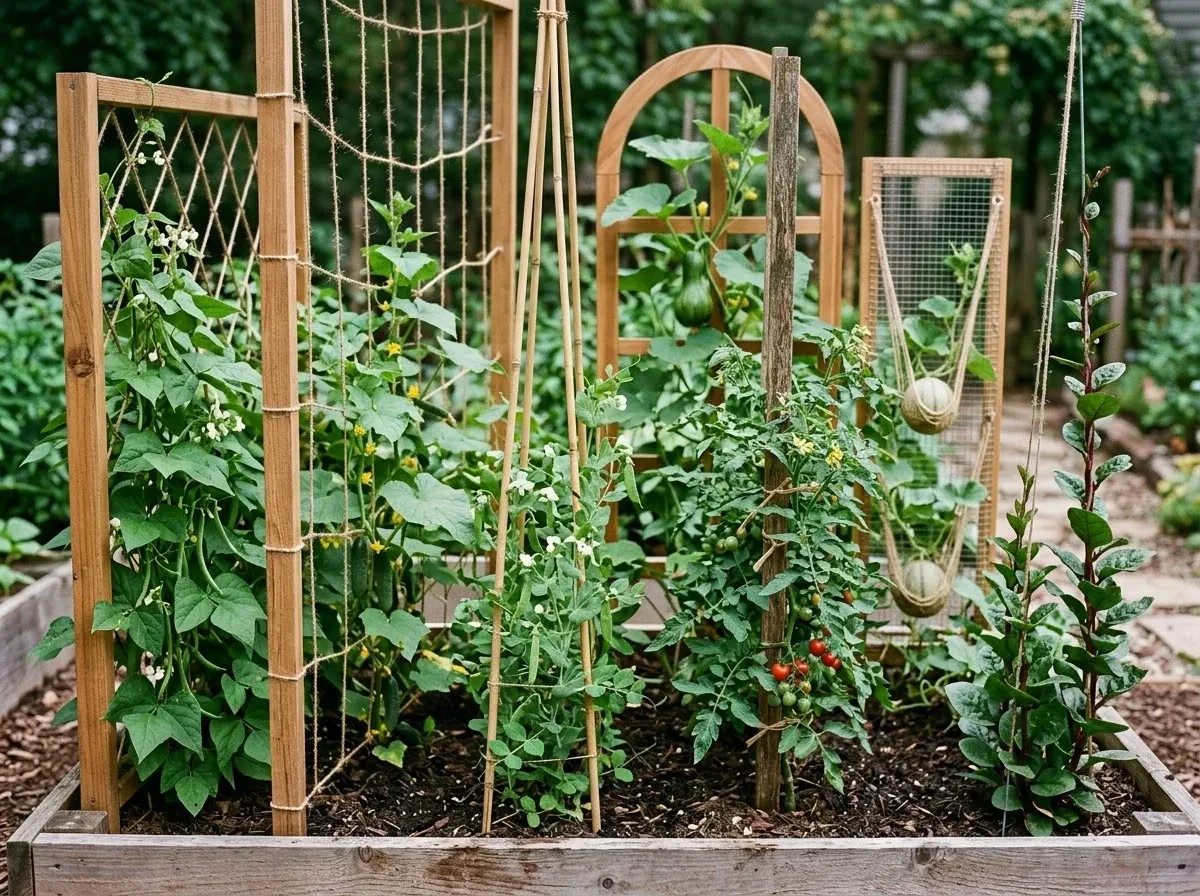
Trellis
A trellis is probably the most versatile option.
It can be made from wood, bamboo, wire, mesh, string or other suitable materials.
Use lighter structures for crops such as peas and stronger structures for heavier vines.
Stakes
A stake takes up very little horizontal space.
It's useful for plants that need individual support rather than a broad climbing surface.
Tomato Cages
Cages help keep supported tomato growth upright.
Make sure the cage is appropriate for the expected mature size of the variety.
Arches
Arches can turn vertical growing into part of the garden's structure.
They can support crops such as beans, peas and cucumbers while also creating a defined garden feature.
Fences
A strong existing fence can sometimes serve as a support for suitable vining vegetables.
NC State Extension specifically notes fences as useful locations for vining vegetables such as peas, beans, cucumbers and melons.
Before using a fence, however, make sure it can safely handle the added weight.
Where Should a Trellis Go in a Small Vegetable Garden?
This is one of the most important decisions in vertical vegetable gardening.
A mature trellis crop can cast considerably more shade than a small seedling.
So don't simply put the tallest structure wherever there happens to be an empty space.
Think about:
Before deciding where to place a trellis, see our guide on how much sun a vegetable garden needs to help plan taller crops around available light.
Sun direction
Mature plant height
Nearby crops
Garden pathways
Watering access
Harvesting access
Airflow
How to Use Vertical Gardening in a Raised Bed
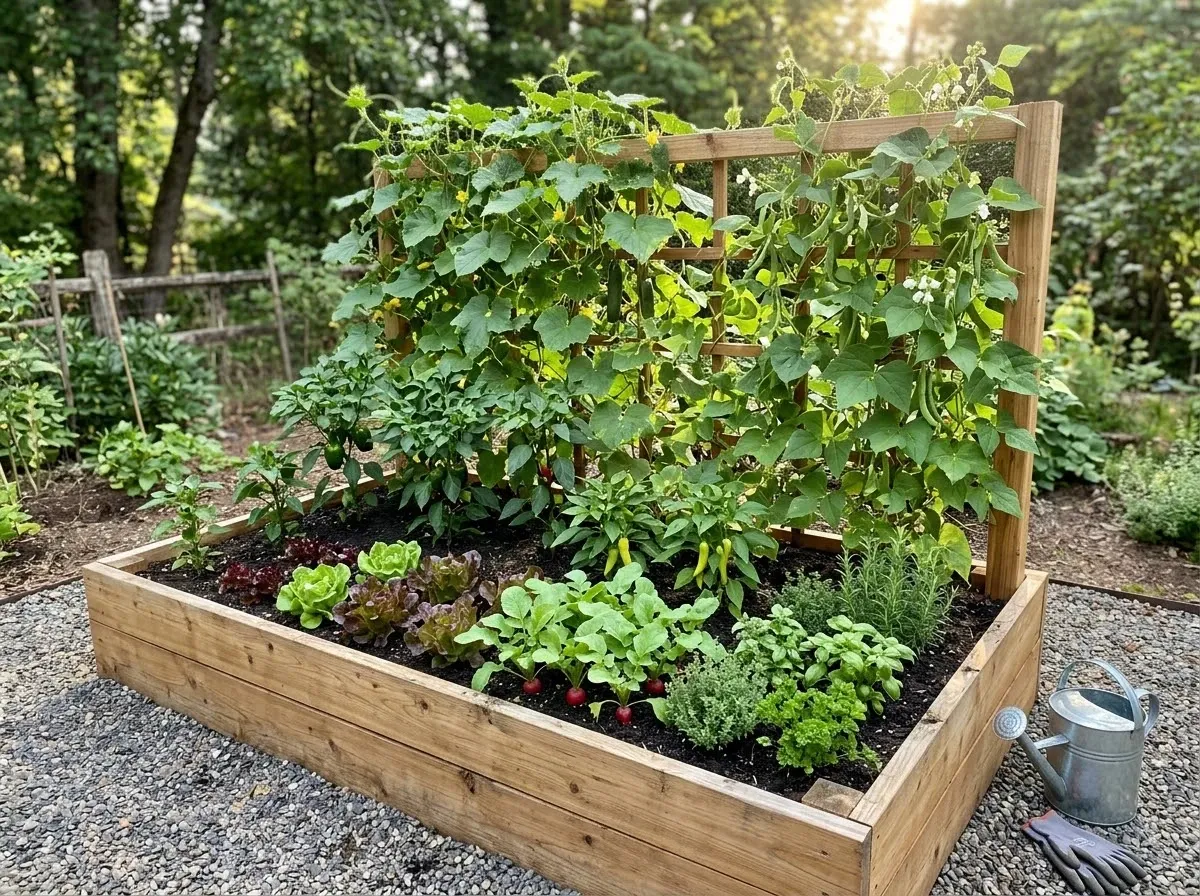
A raised bed can be planned in layers rather than as one flat growing surface.
For example:
Back / tall zone:
Tomatoes or other tall crops
Vertical zone:
Cucumbers, peas or pole beans
Middle zone:
Peppers and medium-height vegetables
Front zone:
Lettuce, radishes and other shorter crops
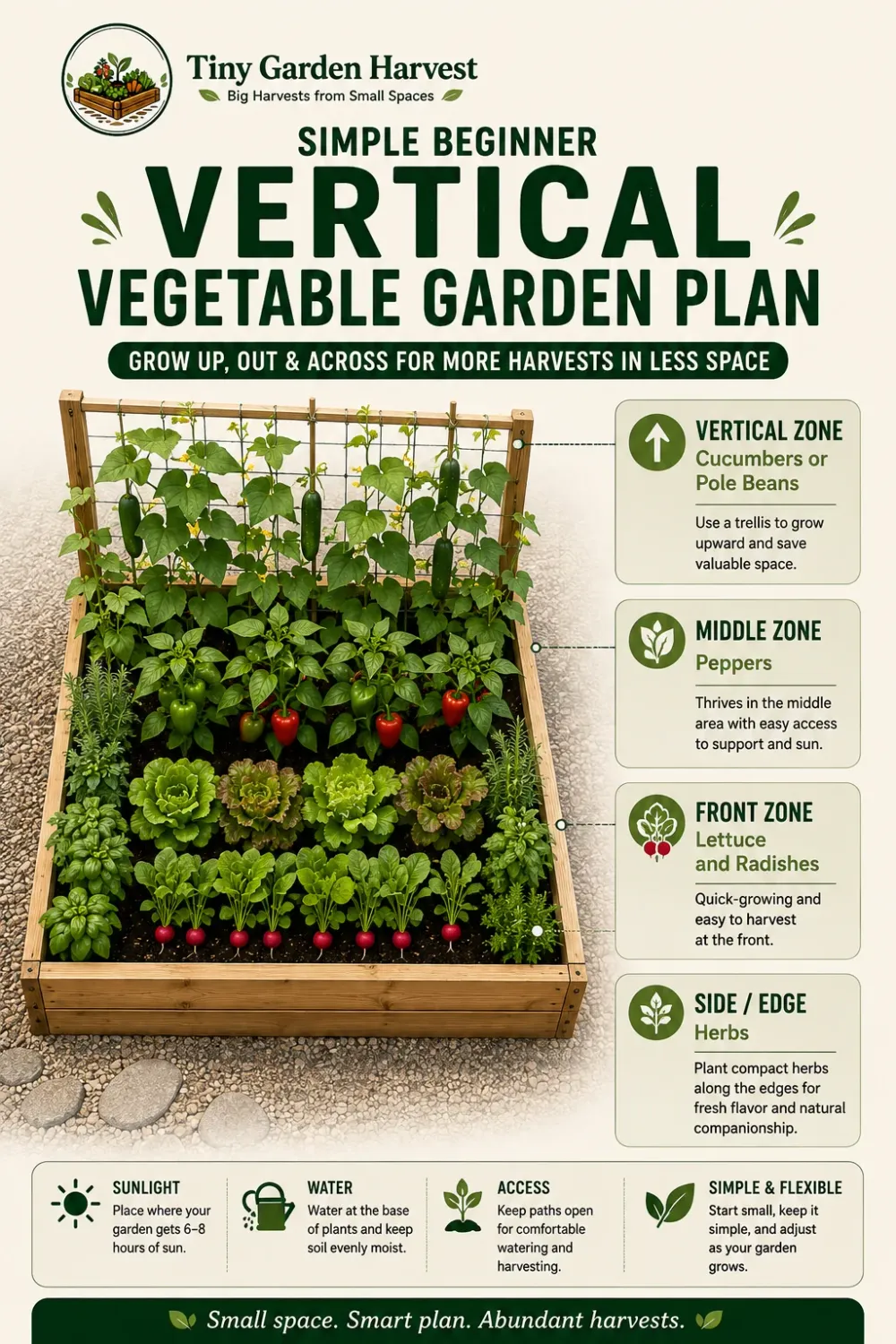
This type of height-based organization is already reflected in the Tiny Garden Harvest 4×8 raised-bed layout, which separates tall, medium, middle/front and front zones and includes a dedicated vertical zone for cucumbers or beans.
For a complete example of organizing crops by height, see our 4×8 raised bed vegetable garden layout.
Does Vertical Gardening Mean You Can Plant Closer Together?
No, not automatically.
This is one of the most important points for beginners.
Growing upward changes where the plant grows, but it doesn't eliminate the plant's need for:
Root space
Sunlight
Water
Nutrients
Airflow
Harvesting access
The Tiny Garden Harvest spacing guidance specifically says to check mature plant size, follow seed-packet recommendations, consider plant height and sunlight, leave room for airflow and provide enough room for watering and harvesting.
Before reducing the distance between plants, check our vegetable plant spacing guide and compare those recommendations with the specific seed packet or plant label.
Vertical Gardening and Airflow
A vertical garden shouldn't become a solid wall of foliage.
Dense growth can make it harder to inspect plants, reach produce and maintain the garden.
A well-planned support should allow you to:
Reach the plant
Water the root zone
See developing fruit
Inspect leaves
Remove damaged growth
Harvest without fighting through a dense mass of foliage
The RHS also recommends allowing air circulation around vertical structures and directing water toward plant roots rather than unnecessarily wetting foliage.
How to Train Vegetables to Grow Vertically
Once the support is installed, training is relatively straightforward.
Use this simple process:
1. Install the support early
Put the trellis, cage or stake in place before the plant becomes difficult to manage.
2. Position the plant close enough to the support
New growth should be able to reach the structure without being forced across a large gap.
3. Guide new growth
Gently direct stems or vines toward the support.
4. Secure when necessary
Use suitable soft ties for crops that need assistance.
The RHS recommends securing non-clinging stems gently with suitable twine rather than tight plastic ties, particularly because some cucurbit stems can be easily constricted.
5. Check regularly
A plant can grow surprisingly quickly once conditions are favorable.
Check the support periodically and redirect growth where needed.
How to Water a Vertical Vegetable Garden
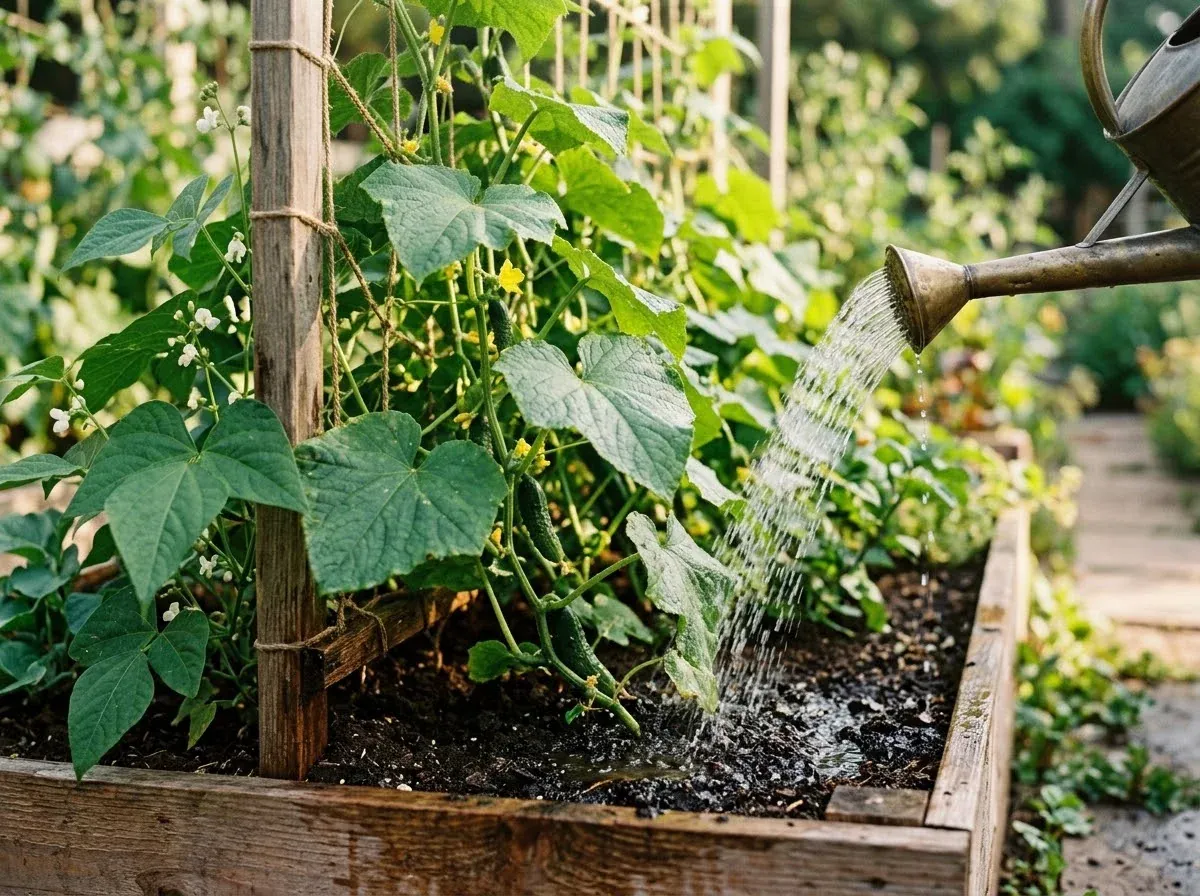
Vertical crops still get their water through the root zone.
So focus your attention at the base of the plant rather than assuming that a tall plant needs a completely different watering method.
Check:
Soil moisture
Recent rainfall
Weather conditions
Plant growth
Drainage
The moisture around the base of dense vines
If your vertical crops are growing in a raised bed, our guide on how to water raised beds explains how to check soil moisture and decide when watering is actually needed.
How to Grow Cucumbers Vertically
Cucumbers are particularly useful when horizontal space is limited.
Instead of allowing the vines to spread across the bed, provide a suitable trellis and guide the new growth upward.
Keep in mind:
Choose a sturdy support.
Give the plants appropriate spacing.
Install the support early.
Guide young growth toward it.
Keep harvesting access clear.
How to Grow Pole Beans Vertically
Pole beans are naturally suited to vertical structures.
A simple trellis, teepee or pole arrangement can give them a direction to climb.
The main planning considerations are:
Support height
Stability
Sunlight
Plant spacing
Harvesting access
Because pole beans climb naturally, they're one of the simpler crops for a beginner to start with.
How to Grow Tomatoes Vertically
Tomatoes can be supported vertically using cages, stakes or trellises.
But variety matters.
Before choosing a support, determine whether the tomato is:
Compact
Determinate
Indeterminate
A smaller container type
A vigorous climbing type
Don't choose a support simply because it looks attractive.
Choose one that matches the plant you're actually growing.
Can Squash and Melons Be Grown Vertically?
Some can.
But this is where beginners need to think about weight, not just height.
A mature vine may be manageable, while the developing fruit creates an additional load.
For heavier fruits, use a strong support and provide individual fruit support where appropriate.
The RHS specifically advises matching the framework to heavier fruits such as squash and pumpkins.
NC State Extension also recommends using a sling or similar support for heavy melons grown vertically along fences.
Common Vertical Gardening Mistakes
Using a weak trellis
A structure that holds a seedling may not hold a mature vine.
Plan for the final size.
Installing the support too late
It's much easier to support a plant before it has sprawled across the bed.
Crowding plants
Vertical growth doesn't remove spacing requirements.
Blocking shorter plants from sunlight
Tall crops need to be positioned thoughtfully.
Ignoring airflow
Don't create an unnecessarily dense wall of leaves.
Making harvesting difficult
If you can't comfortably reach the crop, the design isn't working for you.
Forgetting fruit weight
Heavy cucumbers, squash and melons can put significant stress on supports.
Trying to grow everything vertically
Some crops are better grown horizontally.
Vertical gardening is a tool, not a rule that every plant must follow.
A Simple Beginner Vertical Garden Plan
If this is your first vertical garden, keep it simple.
You don't need a complicated tower, wall system or elaborate structure.
Option 1: Small Raised Bed
Back/side:
One sturdy trellis with cucumbers or pole beans
Middle:
Peppers or other medium-height crops
Front:
Lettuce and radishes
Edge:
Herbs or other compact plants
This gives you a vertical crop while preserving some lower planting space.
Option 2: Patio Containers
Use:
One supported tomato container
One large container for a trellised cucumber
One smaller container for lettuce and herbs
Keep the tallest structures where they won't unnecessarily shade the shorter plants.
Option 3: Fence-Based Garden
If you have a suitable, sturdy fence:
Grow peas or beans along the support.
Train cucumbers where appropriate.
Keep lower-growing crops at the base or nearby.
Maintain access for watering and harvesting.
NC State Extension specifically identifies fences as useful locations for vining vegetables in small-space gardens.
Vertical Gardening vs. Traditional Sprawling Growth
The important takeaway is not that vertical growing is always better.
It's that vertical growing gives a small-space gardener another dimension to work with.
How Vertical Gardening Fits Into Small-Space Gardening
Vertical growing works especially well when combined with other space-saving techniques.
You can combine it with:
Raised beds
Appropriate plant spacing
Succession planting
Compact varieties
Strategic crop placement
Efficient pathways
Companion planting
Container gardening
Vertical growing is only one part of small-space vegetable gardening. Explore our broader guide for additional ways to make limited growing space work harder.
Frequently Asked Questions
What is the easiest vegetable to grow vertically?
Pole beans are a straightforward starting point because they naturally climb a suitable support. Cucumbers and peas are also useful beginner options.
What vegetables should not be grown vertically?
Not every vegetable needs vertical support. Compact crops such as lettuce, radishes, carrots and onions generally don't need a trellis simply because the garden is small.
Can vertical gardening really save space?
It can help use vertical space that would otherwise remain unused, particularly with climbing and vining crops. It does not eliminate the plant's requirements for root space, sunlight, water and nutrients.
Can vertical gardening be used in raised beds?
Yes. A trellis or other support can be incorporated into a raised-bed layout for suitable climbing crops.
How close can vertical vegetables be planted?
Don't automatically reduce spacing because the plant is growing upward. Follow the spacing guidance for the specific crop and variety while considering mature size, airflow, sunlight and access.
Do vertical vegetables need stronger watering?
Not simply because they grow vertically. Their watering needs depend on the crop, growing medium, weather, rainfall and other growing conditions.
Final Thoughts
Vertical vegetable gardening is one of the simplest ways to rethink a small garden.
Instead of seeing your garden as only a patch of ground, think of it as a three-dimensional growing space.
Use a sturdy trellis for cucumbers or pole beans.
Give peas something to climb.
Support appropriate tomato varieties.
Train suitable squash or melons only when the structure can safely handle them.
And keep shorter crops where they can still receive the light and space they need.
Most importantly, don't confuse vertical with overcrowded.
The best small-space garden isn't the one containing the greatest number of plants.
It's the one where every plant has an appropriate place to grow, and where you can still water, inspect, maintain and harvest the garden comfortably.
That is where vertical vegetable gardening becomes genuinely useful.
Ready to Plan Your Vegetable Garden?
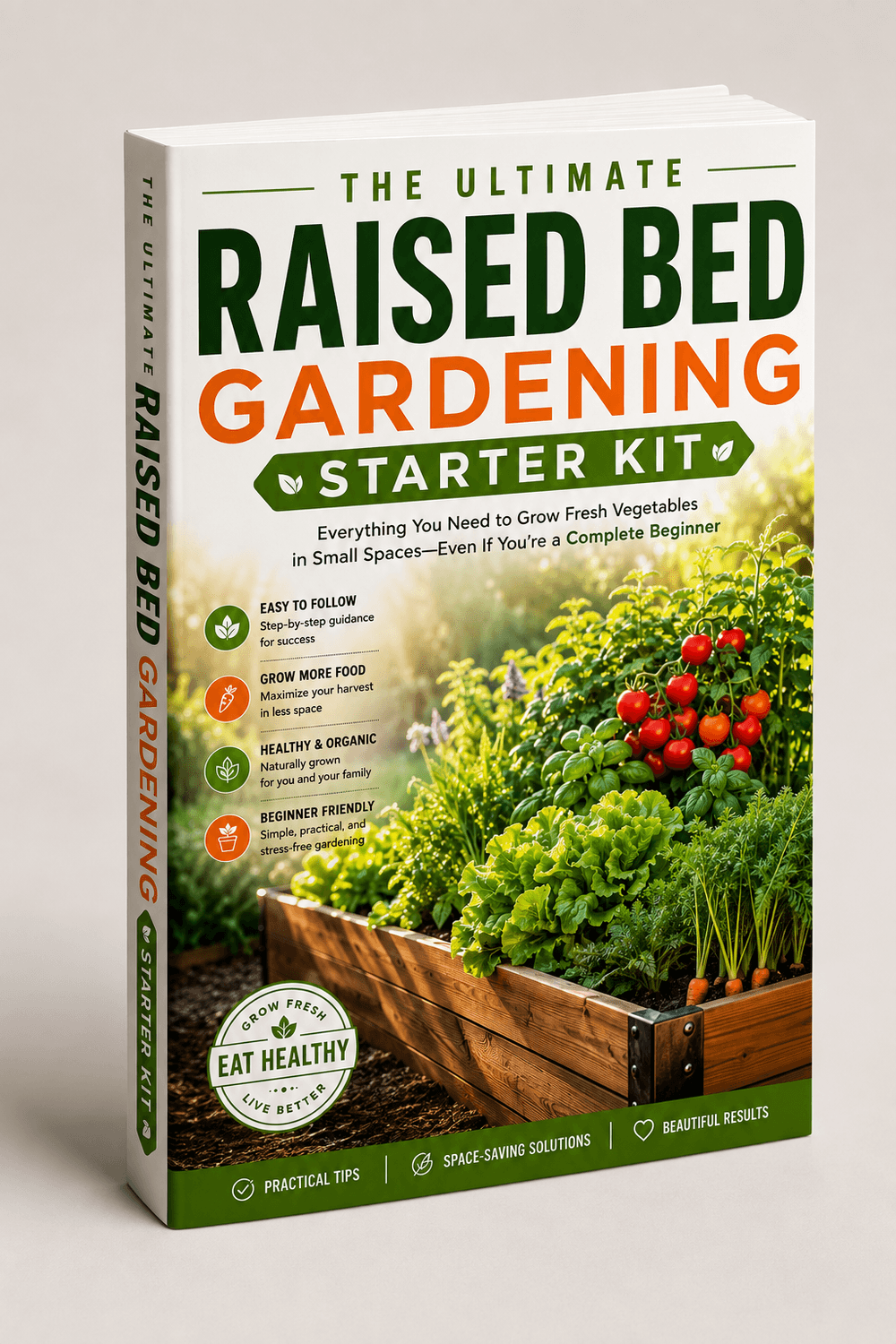
If you're building your first productive garden, the Ultimate Raised Bed Gardening Starter Kit is a natural next step. It brings together practical guidance for planning your bed, choosing soil, spacing vegetables, watering, planting and maintaining a small-space garden.
References
1. NC State Extension. Vegetable Gardening in Small Spaces.
Covers small-space vegetable gardening, including the use of vertical structures and trellising for suitable crops such as beans, peas, cucumbers and melons. NC State Extension — Vegetable Gardening in Small Spaces
2. NC State Extension. Vegetable Gardening.
Provides guidance on vegetable garden planning, crop placement and managing sunlight and space in the garden.
NC State Extension — Vegetable Gardening
3. Royal Horticultural Society (RHS). Vertical Veg.
Provides guidance on vertical vegetable growing, choosing appropriate supports, training plants and supporting heavier crops.
4. Royal Horticultural Society (RHS). How to Grow Cucumbers.
Provides crop-specific guidance for growing cucumbers and supporting climbing plants.
5. Utah State University Extension. Garden Techniques for Limited Space.
Covers techniques for growing vegetables in limited spaces, including trellising and suitable climbing crops.
Utah State University Extension — Garden Techniques for Limited Space
Written by:
Wren Hartley
SHARE




About me

Hi there 👋 I’m Wren Hartley, the creator of Tiny Garden Harvest. I love helping beginners grow fresh food and enjoy bigger harvests from small spaces. 🌱

Trending
learn the basics of location, soil, vegetables, spacing, watering, and care.
Grow more food in less space with raised beds, vertical gardening, and smart crop choices.
Learn an easy raised bed soil mix using topsoil, compost, and aeration material.
Free E-book
Grab your free Ultimate Raised Bed Gardening Starter kit -Ever if you've not garden before.
NEW FREE E-BOOK: Grow Fresh Vegetables in Small Spaces Even If You've Never Gardened Before