
Companion Planting for Beginners: Vegetable Garden Guide & Chart
If you're planning your first vegetable garden and aren't sure which plants should grow together, companion planting gives you a simple place to start.
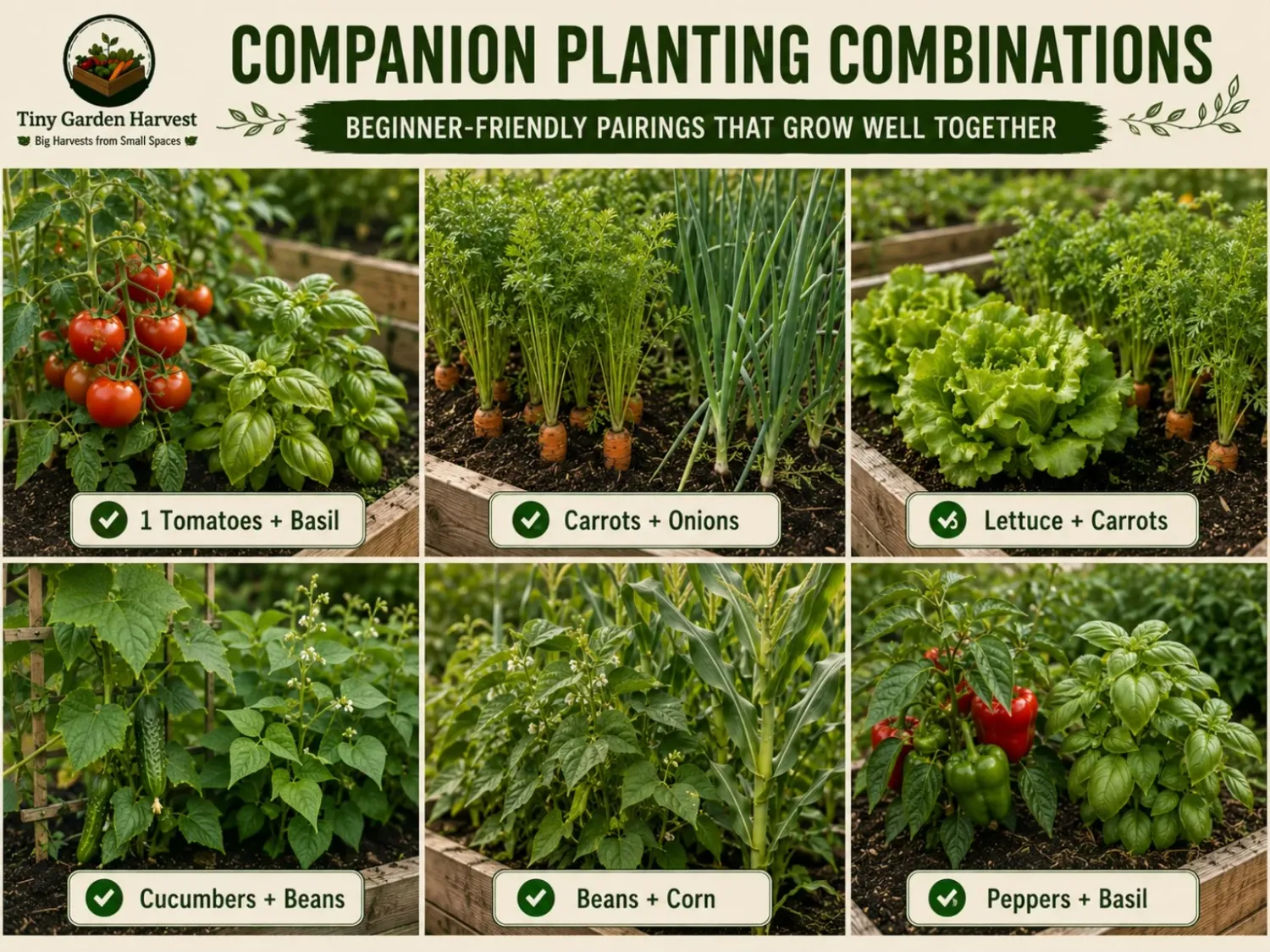
Companion planting is the practice of growing certain plants near one another because the combinations can help make better use of garden space and may support healthy plant relationships. The Tiny Garden Harvest companion planting guide includes practical pairings such as tomatoes with basil, carrots with onions, cucumbers with beans, and peppers with basil.
For beginners, you don't need to memorize every combination.
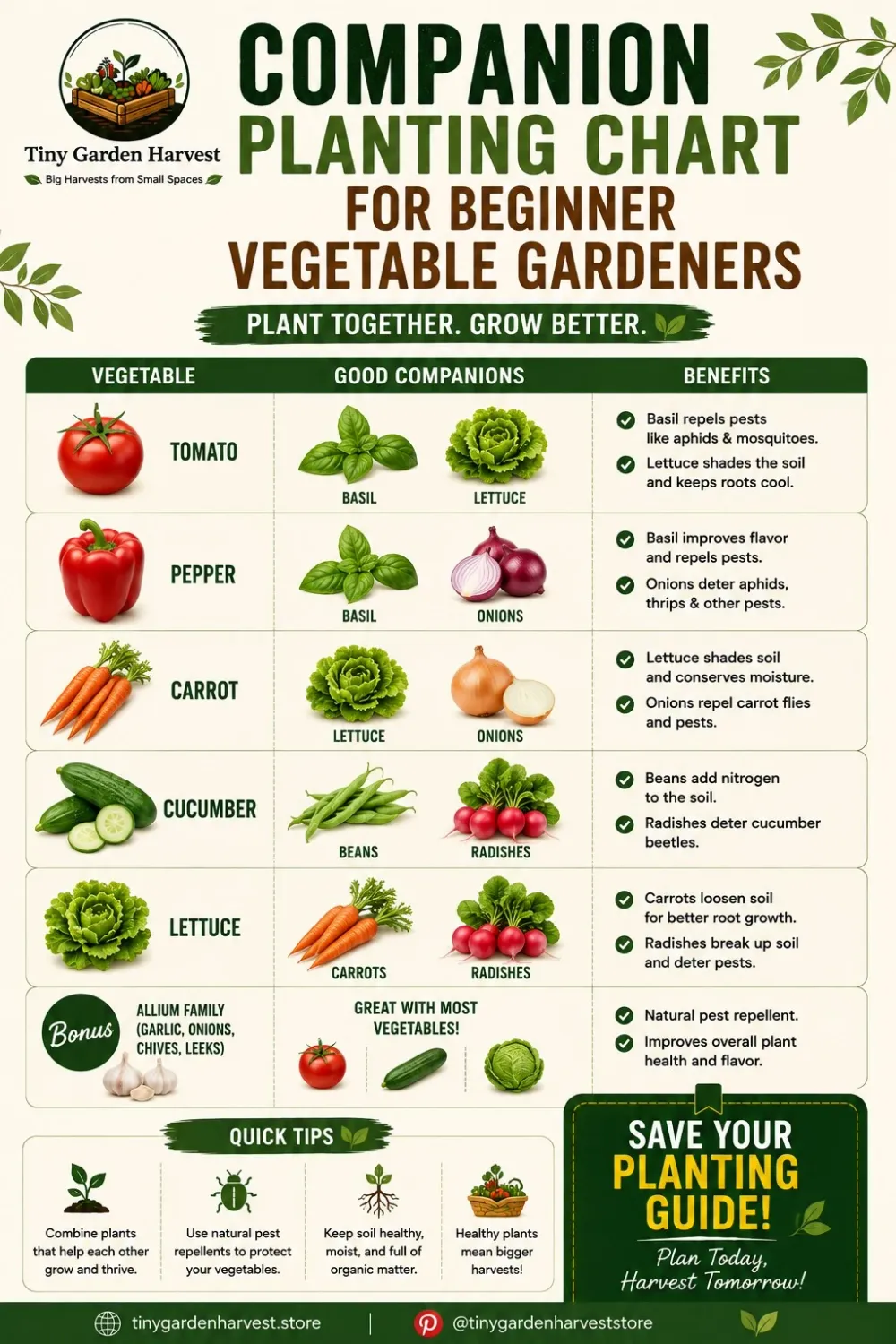
Use the companion planting chart below as a quick reference, then consider sunlight, mature plant size, spacing, soil, watering and airflow when deciding where each crop should go.
Companion Planting Chart for Beginners
The easiest way to start companion planting is to keep a simple reference chart nearby when planning your garden.
The chart below uses the Tiny Garden Harvest companion planting combinations for common raised-bed vegetables.
Beginner Companion Planting Chart
The goal isn't to make your garden complicated. Think of this chart as a planning tool you can return to whenever you're deciding what to plant together.
What Is Companion Planting?
Companion planting means growing certain plants near each other because they may complement one another in the garden.
For a small vegetable garden, the idea is particularly useful because you have limited space to work with.
Instead of thinking about every plant as an isolated crop, you can think about how different plants share the same garden.
A tall crop can occupy vertical space while a shorter crop grows nearby. A root crop can develop below the soil while another crop uses space above it. Herbs can also be tucked into corners and edges rather than requiring their own large planting area.
This makes companion planting especially relevant to raised beds and small-space vegetable gardens.
The Tiny Garden Harvest gardening material notes that herbs can be particularly useful in small spaces because they can be tucked into corners and edges of a vegetable bed.
Why Use Companion Planting in a Vegetable Garden?
Companion planting isn't a replacement for good garden planning. Instead, it can be one part of a larger strategy for organizing your vegetable garden.
1. Make Better Use of Limited Space
Small gardens have one major advantage: they encourage you to plan carefully.
You can combine crops with different growth habits so that one garden area does more than one job.
For example:
Tomatoes provide height.
Basil occupies lower growing space.
Carrots develop underground.
Lettuce stays relatively low.
Beans and cucumbers can make use of vertical supports.
Herbs can fit into corners and edges.
This approach fits naturally with the Tiny Garden Harvest philosophy of growing more food in limited spaces.
2. Add More Variety to Your Garden
A small raised bed doesn't have to contain just one vegetable.
With careful planning, you can combine several crops and create a more diverse harvest.
For a beginner, that could mean growing tomatoes, basil, peppers, carrots, lettuce and onions in the same general garden area while still giving each crop enough room.
3. Make Garden Planning Easier
Companion planting can also give you a starting point when you're staring at a blank garden bed and wondering what belongs where.
Instead of randomly placing vegetables, start by choosing one or two main crops.
Then use the chart to identify compatible plants that can share the space.
10 Beginner-Friendly Companion Planting Combinations
You don't need to use every combination in the chart.
Start with a few that fit the vegetables you already want to grow.
1. Tomatoes + Basil
Tomatoes and basil are one of the simplest combinations for a beginner to try.
Basil loves full sun and warmth and is specifically identified in the Tiny Garden Harvest gardening guide as a plant that pairs well with tomatoes.
When planting them together, don't crowd the tomato plant. The tomato still needs sufficient room for its mature growth.
Beginner tip: Think of basil as a companion crop around the tomato rather than filling every available gap with basil.
2. Carrots + Onions
Carrots and onions are another useful combination for a mixed vegetable bed.
Carrots develop their edible roots below the soil, while onions have a different growth pattern above the soil.
This can help you use the available growing area more efficiently.
3. Lettuce + Carrots
Lettuce and carrots can work well in a compact vegetable garden.
Lettuce provides a low-growing leafy crop while carrots develop their roots underground.
This is particularly useful when you want to grow several vegetables without needing a large garden.
4. Cucumbers + Beans
Cucumbers and beans can be useful companions when you're planning to grow vertically.
Both crops can benefit from appropriate support, allowing you to use vertical space rather than relying entirely on ground-level space.
5. Beans + Corn
Beans and corn are another combination included in the Tiny Garden Harvest companion planting guide.
Corn grows upward, while beans can make use of vertical structure.
The important lesson for small-space gardeners is to consider how plants occupy space, not just how many plants you can fit into a bed.
6. Peppers + Basil
Peppers and basil can be combined in a warm, sunny garden area.
The Tiny Garden Harvest guide lists basil, onions and carrots as companion plants for peppers and identifies fennel as a plant to avoid planting near them.
7. Cucumbers + Radishes
Radishes are relatively compact and can be included in a mixed vegetable garden with cucumbers.
Because the crops have different growth patterns, the combination can be useful when planning a small bed.
8. Cabbage Family + Dill
The cabbage family includes crops such as:
Cabbage
Broccoli
Cauliflower
Kale
The Tiny Garden Harvest companion chart lists dill, onions and beets as companion options for cabbage family crops.
9. Onions + Lettuce
Onions and lettuce can share space in a mixed vegetable bed.
Lettuce remains relatively low, while onions occupy space differently.
As always, use the mature size and spacing recommendations for the particular varieties you're growing.
10. Squash/Zucchini + Beans
Squash and zucchini can be grown with beans and other compatible crops.
The main challenge is space.
Squash plants can become large, so plan their direction of growth before planting. A small garden can quickly become crowded if sprawling crops aren't given enough room.
How to Plan Companion Planting in a Small Vegetable Garden
The best companion planting plan isn't necessarily the one with the most combinations.
It's the one that fits your available space.
Use this simple process.
Step 1: Measure Your Garden Space
Start with the actual dimensions of your raised bed, garden plot, container area or other growing space.
Knowing your available space makes it much easier to decide which vegetables belong in the garden.
Step 2: Choose the Vegetables You Actually Want to Eat
Don't fill your garden with vegetables simply because they appear on a companion planting chart.
Choose crops your household will actually use.
For your first garden, the Tiny Garden Harvest starter material recommends choosing around 4–6 crops rather than attempting to grow everything at once. It also suggests mixing quick growing crops such as radishes and lettuce with longer-season crops such as tomatoes and peppers.
That approach can make your first garden easier to manage.
Step 3: Group Compatible Plants
Once you've chosen your main crops, use the companion chart to identify possible partners.
For example:
Main crop: Tomatoes
Possible companions: Basil, carrots, onions and parsley
Or:
Main crop: Cucumbers
Possible companions: Beans, peas, radishes and dill
This gives you a starting point without forcing you to follow a complicated planting system.
Step 4: Check Mature Plant Size
This is one of the most important steps.
A young seedling may take up very little space, but the mature plant can become much larger.
Before planting, check the recommended spacing for your particular crop and variety.
For example, the Tiny Garden Harvest starter material lists approximate spacing ranges such as 2–3 inches for carrots, 16–18 inches for peppers and 24–36 inches for zucchini.
Don't sacrifice plant health just to squeeze another crop into the bed.
Step 5: Plan for Sunlight and Plant Height
A good companion planting plan considers more than the names on a chart.
Think about where sunlight will fall throughout the day.
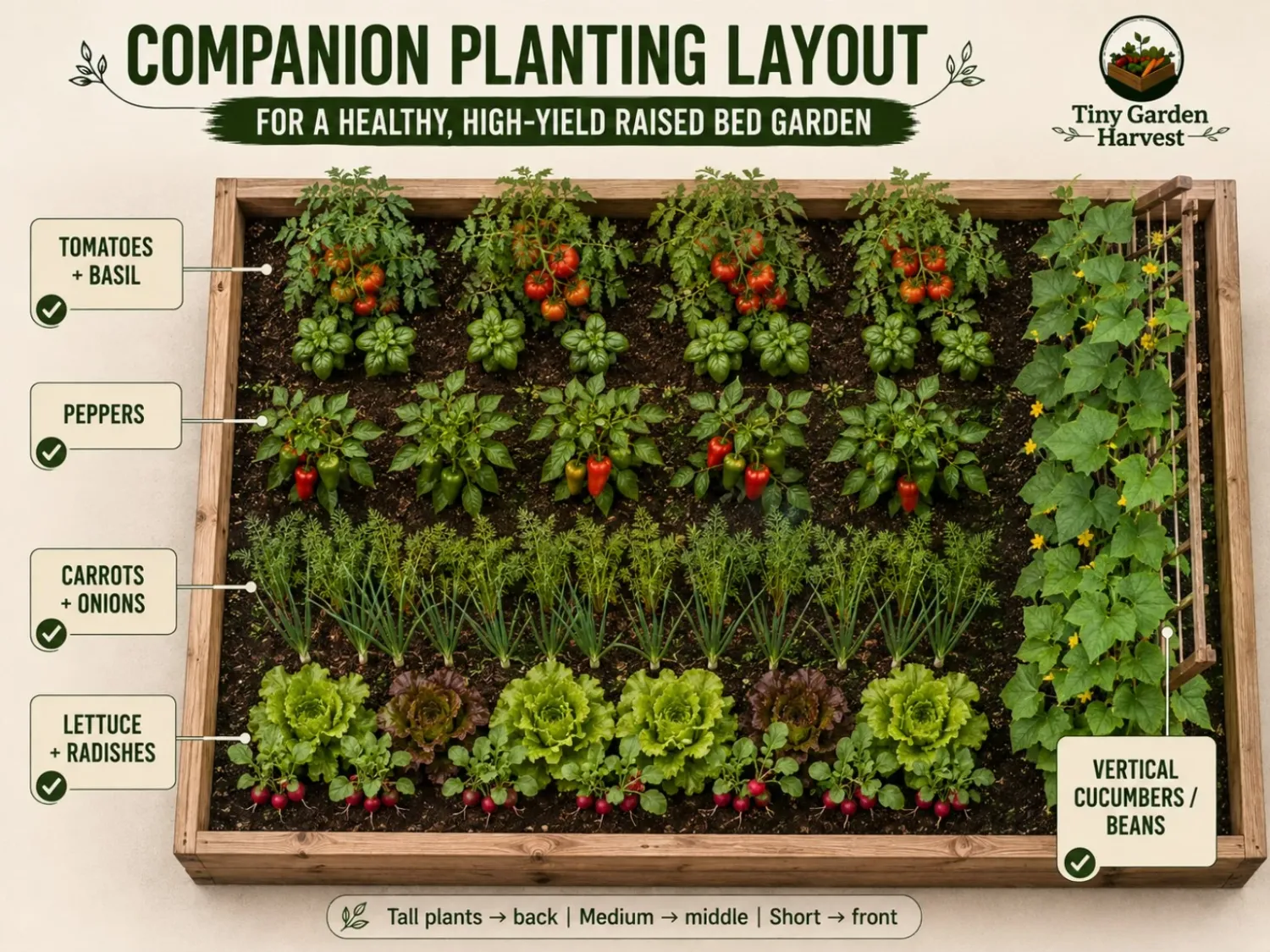
A simple layout principle is:
Tall plants → back
Medium plants → middle
Short plants → front
This reduces the chance of taller crops unnecessarily shading shorter plants.
Step 6: Leave Enough Room for Airflow
Companion planting does not mean planting everything as close together as possible.
Plants still need adequate room for growth and airflow.
Overcrowding can make garden maintenance more difficult and can create conditions that are less favorable for plant health.
Companion Planting for Raised Beds
Raised beds are particularly suitable for this type of planning because the growing area is clearly defined.
You can divide the bed into broad zones based on:
Plant height
Mature size
Sunlight
Root space
Vertical growth
Harvest timing
Companion relationships
For example, a beginner-friendly raised bed might include:
This doesn't mean every raised bed needs exactly this arrangement. Adjust the plan according to your garden's dimensions, sunlight and the varieties you're growing.
Companion Planting Mistakes Beginners Should Avoid
Companion planting becomes much easier when you know what not to do.
Mistake 1: Planting Too Many Crops Together
A companion planting chart doesn't tell you how many plants can fit into your garden.
Spacing still matters.
Choose a manageable number of crops and give them room to reach their mature size.
Mistake 2: Ignoring Sunlight
Two plants may appear compatible on a chart but still struggle if one blocks too much sunlight from the other.
Before planting, consider the mature height of every crop.
Mistake 3: Ignoring Mature Plant Size
Squash and zucchini are good examples.
A small seedling may look harmless, but a mature plant can occupy a large amount of garden space.
Plan where sprawling plants will grow before you plant them.
Companion planting isn't a magic solution.
Your results can still depend on:
Soil quality
Watering
Sunlight
Plant spacing
Climate
Crop variety
Pest and disease pressure
Garden maintenance
Mistake 5: Forgetting About Your Own Gardening Goals
The best garden is one that produces crops you actually want to harvest.
If you don't eat beets, you don't need to grow beets simply because they have compatible companions.
Start with vegetables you enjoy.
What Vegetables Should Not Be Planted Together?
The Tiny Garden Harvest companion planting chart identifies several combinations to keep apart when planning a raised bed.
Examples include:
Tomatoes and cabbage-family plants
Tomatoes and fennel
Peppers and fennel
Cucumbers and aromatic herbs such as sage
Beans and onions
Beans and garlic
Carrots and large quantities of dill
Cabbage-family plants and tomatoes
Beets and pole beans
How to Make Companion Planting Work in a Small Garden
You don't need to memorize this list.
Save the chart or keep it nearby when planning your next garden.
If your garden is small, focus on space efficiency rather than trying to grow everything.
Here are a few practical ideas.
Use Vertical Space
Cucumbers and beans can be grown with suitable support, allowing you to use vertical space.
This can be particularly helpful in compact gardens.
Use Garden Edges for Herbs
Herbs can be tucked into corners and edges of vegetable beds.
The Tiny Garden Harvest starter material specifically recommends using small-space herbs this way rather than giving every herb its own dedicated area.
Basil, thyme, parsley, rosemary and other suitable herbs can become useful parts of a mixed garden plan.
Combine Different Growth Habits
Think about your garden in layers:
Above the soil: tomatoes, peppers and leafy crops
At soil level: lettuce and herbs
Below the soil: carrots and other root crops
Vertical: beans and cucumbers with suitable support
This way of thinking can help you make better use of a limited growing area.
A Simple Companion Planting Plan for Your First Raised Bed
If this is your first vegetable garden, don't try to create the most complicated companion planting plan possible.
Start with a few crops.
For example:
Back of the bed:
Tomatoes + basil
Middle:
Peppers
Middle/front:
Carrots + onions
Front:
Lettuce + radishes
Vertical support:
Beans or cucumbers
Then observe how the plants grow.
You can adjust your layout in the next growing season based on what worked well and what became crowded.
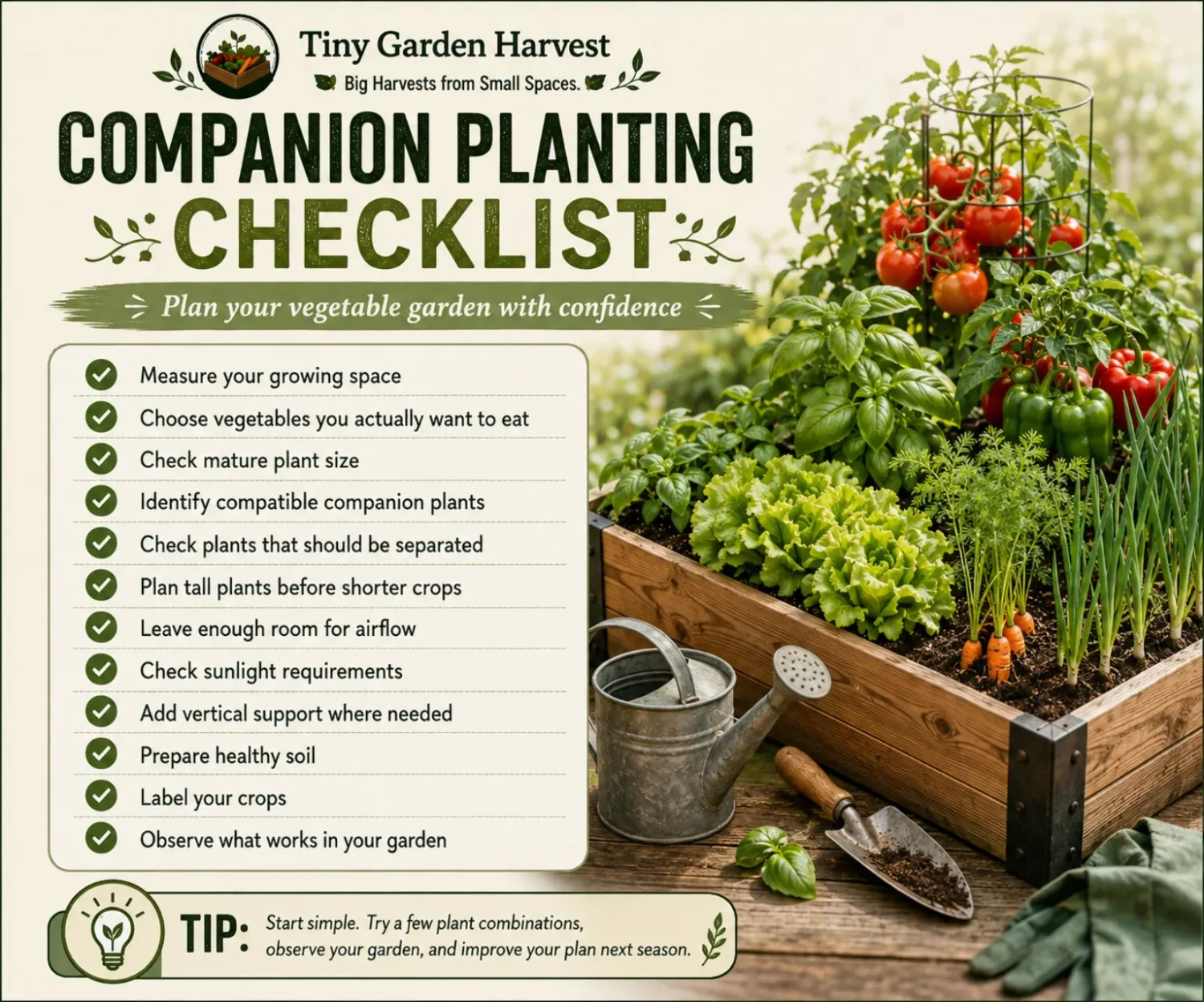
Companion Planting Checklist for Beginners
Before planting, use this quick checklist.
Measure your growing space.
Choose vegetables you actually want to eat.
Check each crop's mature size.
Review compatible companion plants.
Check which plants should be separated.
Plan vertical supports where needed.
Prepare healthy soil.
Check watering requirements.
Label your crops.
Observe your garden throughout the season.
The goal isn't perfection.
Your first garden is also an opportunity to learn what works in your particular space.
Frequently Asked Questions About Companion Planting
What is companion planting?
Companion planting is the practice of growing certain plants near one another because the combination may provide useful relationships in the garden or make better use of available space.
What is the best companion plant for tomatoes?
Basil is one of the simplest tomato companion plants to start with. The Tiny Garden Harvest companion guide also lists carrots, onions and parsley as companions for tomatoes.
Can tomatoes and basil grow together?
Yes. Tomatoes and basil are listed together in the Tiny Garden Harvest companion planting guide, and basil is described in the gardening starter material as pairing well with tomatoes.
What vegetables grow well together?
Examples from the Tiny Garden Harvest companion chart include:
Tomatoes + basil
Carrots + onions
Lettuce + carrots
Cucumbers + beans
Beans + corn
Peppers + basil
Use the complete chart above for additional combinations.
What vegetables should not be planted together?
The chart identifies combinations such as tomatoes with cabbage-family plants, tomatoes with fennel, beans with onions or garlic, peppers with fennel, and beets with pole beans.
Is companion planting good for raised beds?
It can be useful in raised beds because it encourages you to consider plant relationships alongside spacing, plant height, sunlight and available growing space.
Can I use companion planting in a small garden?
Yes. Companion planting can fit naturally into small-space gardening because you can combine crops with different growth habits and make better use of vertical, above-ground and below-ground space.
Do I need companion planting to grow vegetables successfully?
No.
You can grow a productive vegetable garden without companion planting.
Good soil, appropriate crops, sufficient sunlight, correct spacing, suitable watering and regular care remain important foundations of vegetable gardening.
Companion planting is simply another planning tool you can use.
Final Thoughts: Start Simple
Companion planting doesn't have to be complicated.
You don't need to memorize every plant combination before planting your first vegetable garden.
Start with a few straightforward pairings:
Tomatoes + basil
Carrots + onions
Lettuce + carrots
Cucumbers + beans
Peppers + basil
Then pay attention to how your plants perform.
Look at the amount of space they use, how much sunlight they receive, whether the garden becomes crowded and how easy the bed is to maintain.
Over time, you'll develop a planting system that works for your own garden.
And if you're gardening in a small backyard or raised bed, remember that good planning can help you make much more of the space you already have.
Ready to Plan Your Vegetable Garden?
If you're starting your first raised bed, get the Ultimate Raised Bed Gardening Starter Kit for beginner-friendly help with planning your garden, choosing vegetables and preparing your growing space.
Written by:
Wren Hartley
SHARE




About me
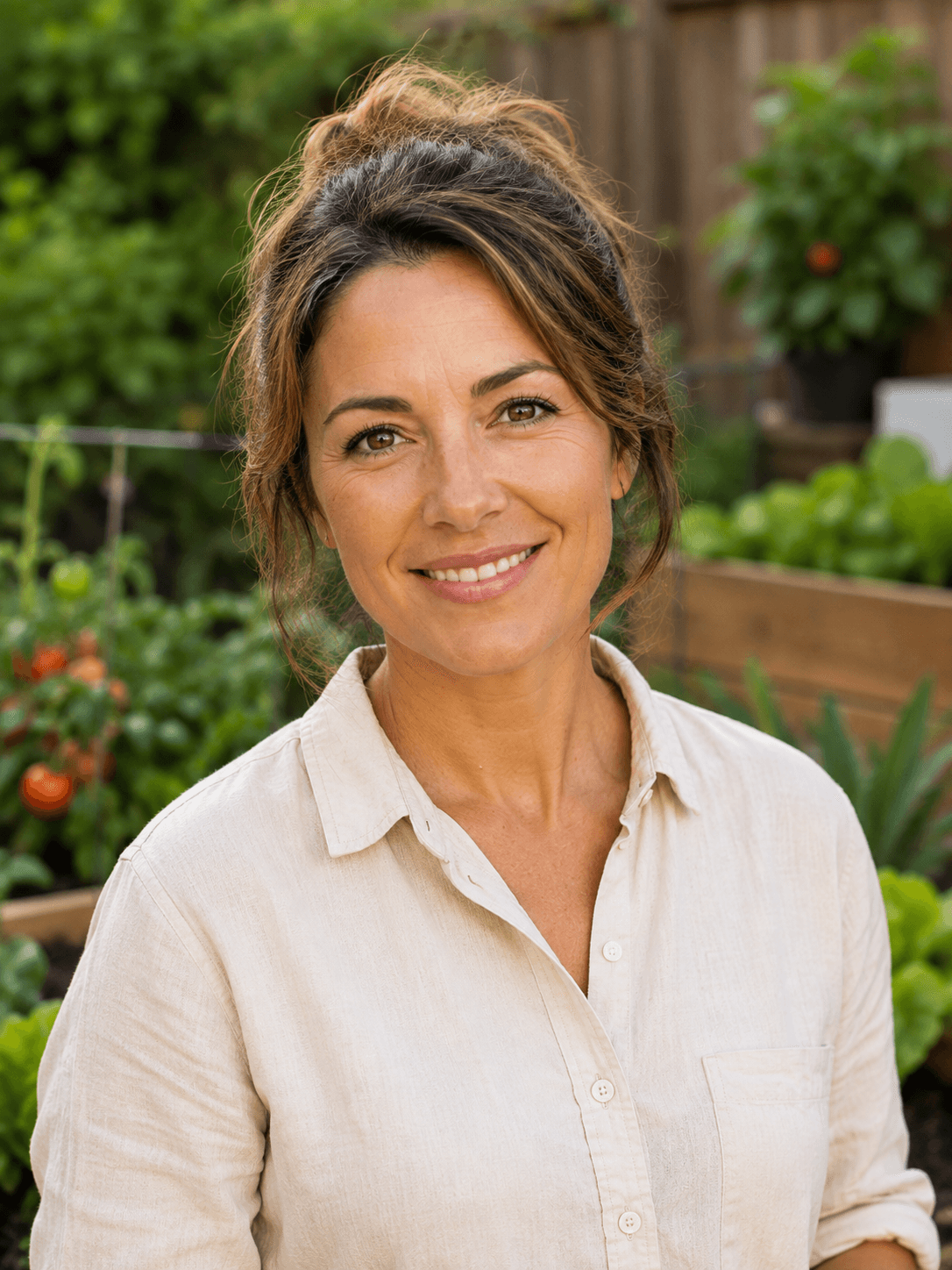
Hi there 👋 I’m Wren Hartley, the creator of Tiny Garden Harvest. I love helping beginners grow fresh food and enjoy bigger harvests from small spaces. 🌱

Trending
learn the basics of location, soil, vegetables, spacing, watering, and care.
Grow more food in less space with raised beds, vertical gardening, and smart crop choices.
Learn an easy raised bed soil mix using topsoil, compost, and aeration material.
Free E-book
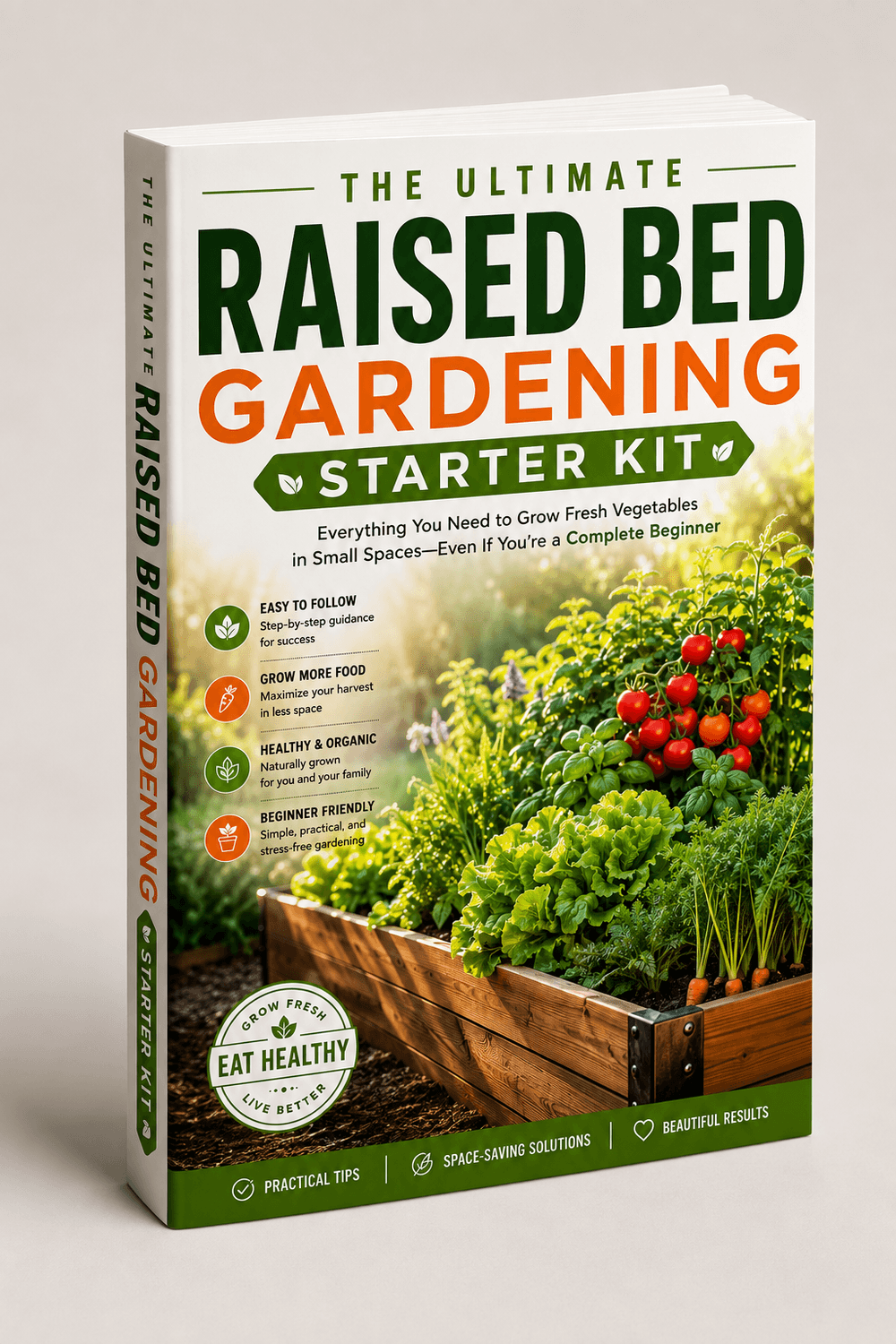
Grab your free Ultimate Raised Bed Gardening Starter kit -Ever if you've not garden before.
NEW FREE E-BOOK: Grow Fresh Vegetables in Small Spaces Even If You've Never Gardened Before